Run 1 ·
Personal site for a writer: Opus 5.5 vs GPT-6.1 Sol
A personal website for a writer the agent invents, with posts worth reading.
Short answer: from the same prompt, Opus 5.5 took 14 min and 18% of a 5-hour limit; GPT-6.1 Sol took 13 min and 6% of a 5-hour limit. Both builds are live below, with their full source code.
| Claude ProOpus 5.5 | ChatGPT PlusGPT-6.1 Sol | |
|---|---|---|
| Time | 14 min | 13 min |
| 5-hour limit usedClaude Code ran as claude -p, which uses about 1.7 to 1.8 times as much of the 5-hour limit per token as an interactive Claude Code session. | 18% | 6% |
| Same work on the APIat list prices | $3.13 | $0.50 |
| Files in the code | 24 | 30 |
| Lines in the codelockfiles left out | 1,671 | 569 |
| npm packages | 0 | 0 |
| Published app size | 1.3 MB | 6.3 MB |
What did each agent say it built?
The last message each agent wrote when it finished, unedited.
Opus 5.5 Claude Pro
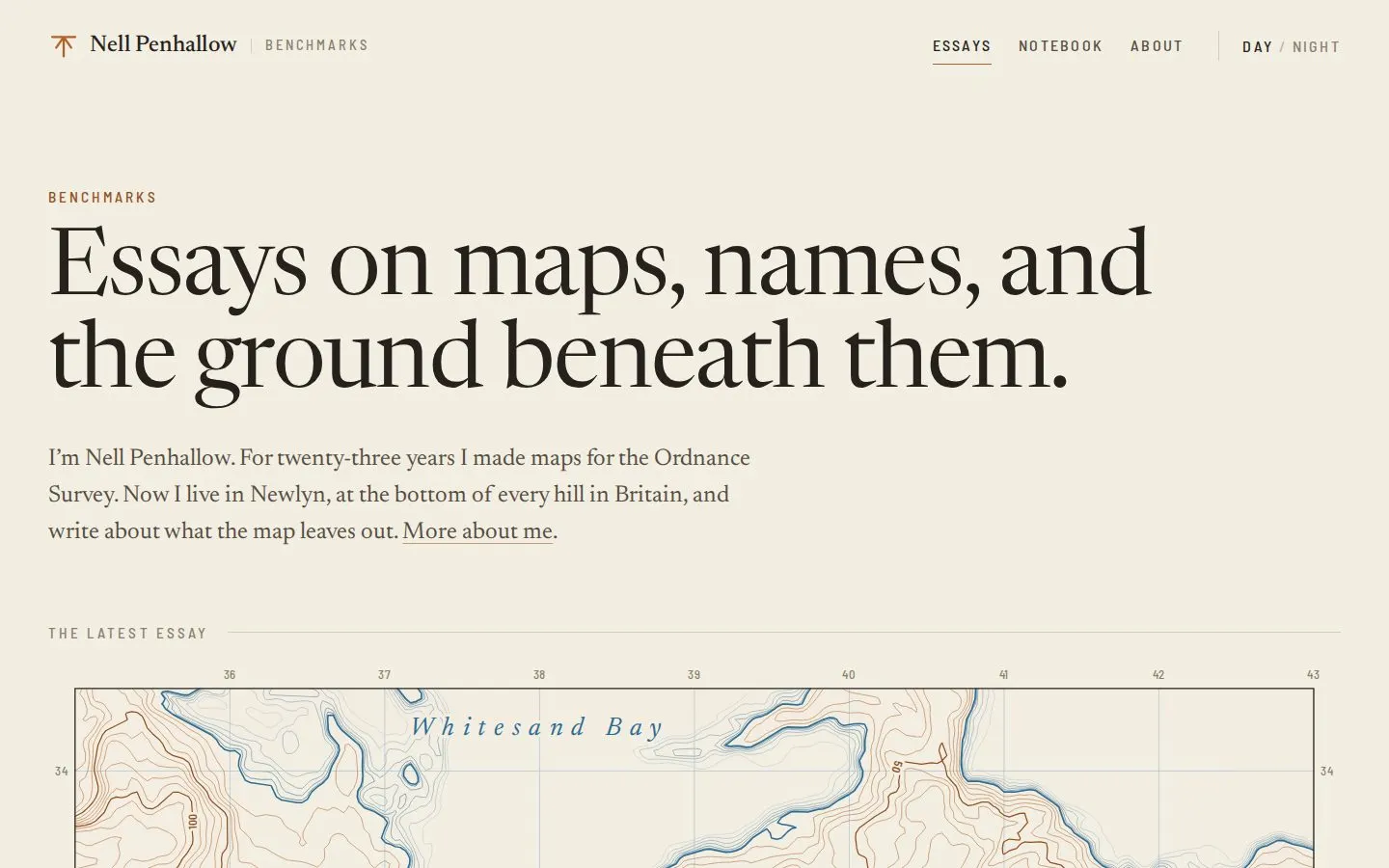
I built Benchmarks, the personal site of Nell Penhallow, a writer I invented. She spent 23 years making maps for the Ordnance Survey, the UK's national mapping agency, and now lives in Newlyn in Cornwall. Every height on every map of mainland Britain is measured from a tide gauge on the pier there. She writes essays about maps, place names, and what the map leaves out. A clean build serves correctly using the run.json commands, and I've committed everything.
The writing
- Five essays of 900–1,400 words each, written in her voice:
- The Zero at Newlyn: the tide-gauge hut that all British heights are measured from.
- Trap Streets: the fake town of Agloe, and the small lies every map has to tell.
- Pity Me, and Other Places: her years checking place names.
- Drawing the Hill: learning to cut contours by hand on a hill she had never seen, then finally climbing it.
- Nothing Shown: a day spent in an empty square of the map.
- A notebook of short dated field notes, and an about page.
- Real facts in the essays (Newlyn's datum readings 1915–21, Agloe, OS benchmarks, Cornish place names) were checked from memory, not against sources. Her life and anecdotes are invented.
The design
- A generated map for every essay. Each one gets its own imaginary contour map, drawn at build time from a seed, so it never changes. It's styled like an OS sheet: brown contours every 10 m, blue lines shading the water near the coast, a 1 km grid with numbers in the margin, and height labels that face uphill (a convention one of the essays mentions). Each has a summit marker, a benchmark, and the essay's place names lettered on, with labels kept from overlapping. Smaller versions of the same maps appear as thumbnails on the home page.
- Margin notes sit beside the text on wide screens; on phones you tap the number and the note opens in place.
- Typography: Newsreader for the text, with indented paragraphs and the opening words in small capitals, and Barlow Semi Condensed for map-style labels. Both fonts are self-hosted.
- Small touches: a night mode (follows the system setting, with a Day/Night switch), the benchmark symbol as logo and end-of-essay mark, a map scale bar in the footer, a 404 page that says "You have walked off the edge of the sheet", and an RSS feed.
Stack: plain Node with no dependencies. src/build.js builds the site into dist/, src/terrain.js draws the maps, and serve.js is a small static server.
{ "build": "node src/build.js", "start": "node serve.js" }I checked it in headless Chrome on desktop and phone widths, in day and night colours: the home page, every essay map, the notebook, the 404 page, the night switch and opening a margin note on a phone. Pages without a home-page thumbnail grid weigh about 85–105 KB; the home page is about 170 KB.
No npm packages.
GPT-6.1 Sol ChatGPT Plus
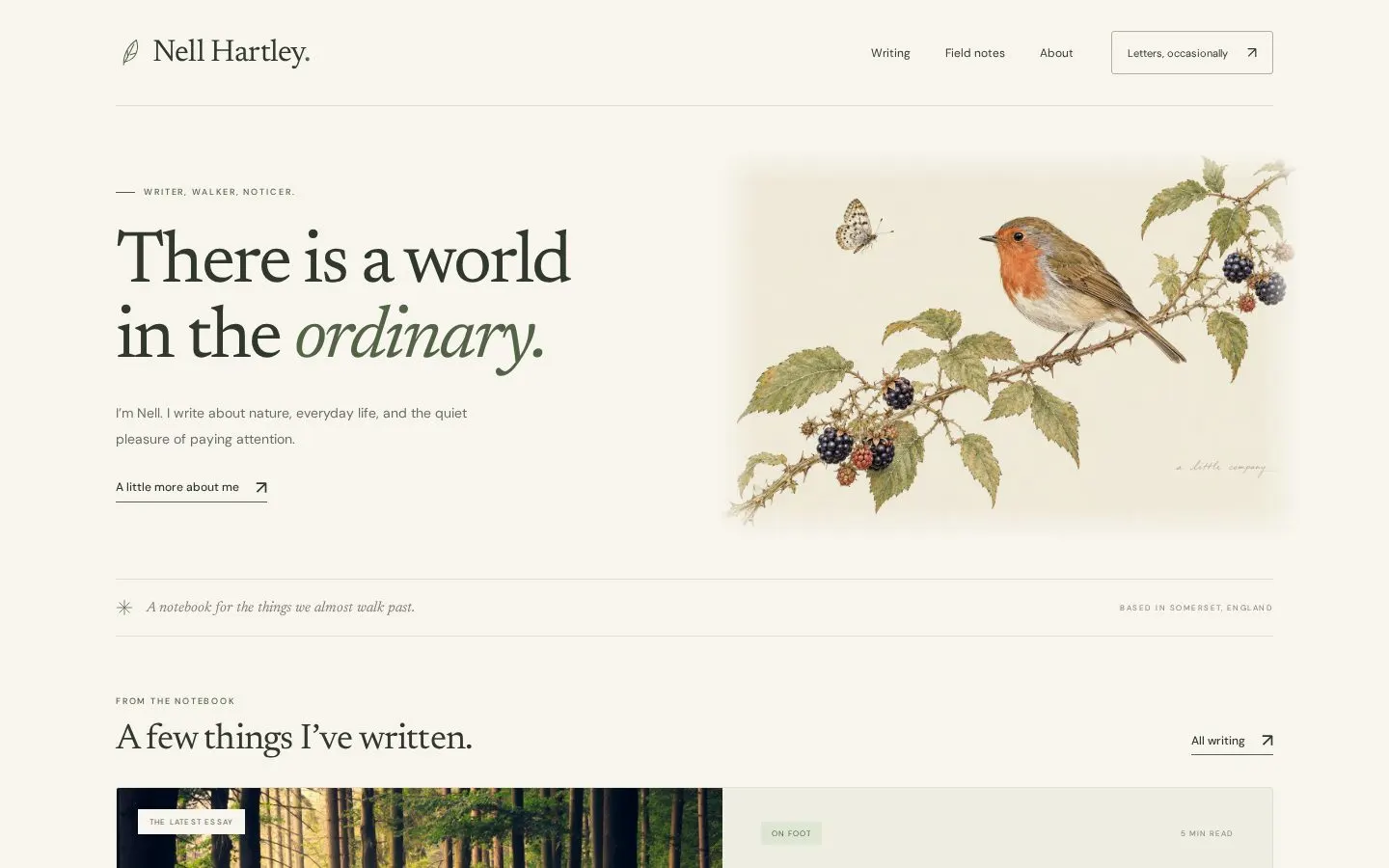
Built Nell Hartley’s notebook: a warm, literary website with four original essays, six field notes, custom artwork, and carefully set reading pages.
Includes searchable writing, saved essays, mobile navigation, and locally stored newsletter signups. Browser checks and build passed.
Ready to run via run.json. Artwork and prompts.
No npm packages.
What was the prompt?
Both agents got this brief once, followed by the delivery contract that ends every prompt. Download the full prompt (.md)
A personal website for a writer
Build a personal website for a writer who would never use a WordPress theme.
Invent the writer: who they are, what they do, what they write about. Then write a few of their posts. The site should feel like that person, and reading on it should be a pleasure. Design, typography and any illustrations are yours.