Run 1 ·
Future car · 3D showroom: Opus 5.5 vs GPT-6.1 Sol
A self-driving car from 2036 in a 3D showroom, built in code, that comes apart into transparent pieces and back together.
Short answer: from the same prompt, Opus 5.5 took 46 min and 47% of a 5-hour limit; GPT-6.1 Sol took 35 min and 13% of a 5-hour limit. Both builds are live below, with their full source code.
| Claude ProOpus 5.5 | ChatGPT PlusGPT-6.1 Sol | |
|---|---|---|
| Time | 46 min | 35 min |
| 5-hour limit usedClaude Code ran as claude -p, which uses about 1.7 to 1.8 times as much of the 5-hour limit per token as an interactive Claude Code session. | 47% | 13% |
| Same work on the APIat list prices | $8.51 | $1.10 |
| Files in the code | 29 | 18 |
| Lines in the codelockfiles left out | 3,061 | 1,170 |
| npm packages | 4 | 3 |
| Published app size | 950 KB | 894 KB |
What did each agent say it built?
The last message each agent wrote when it finished, unedited.
Opus 5.5 Claude Pro
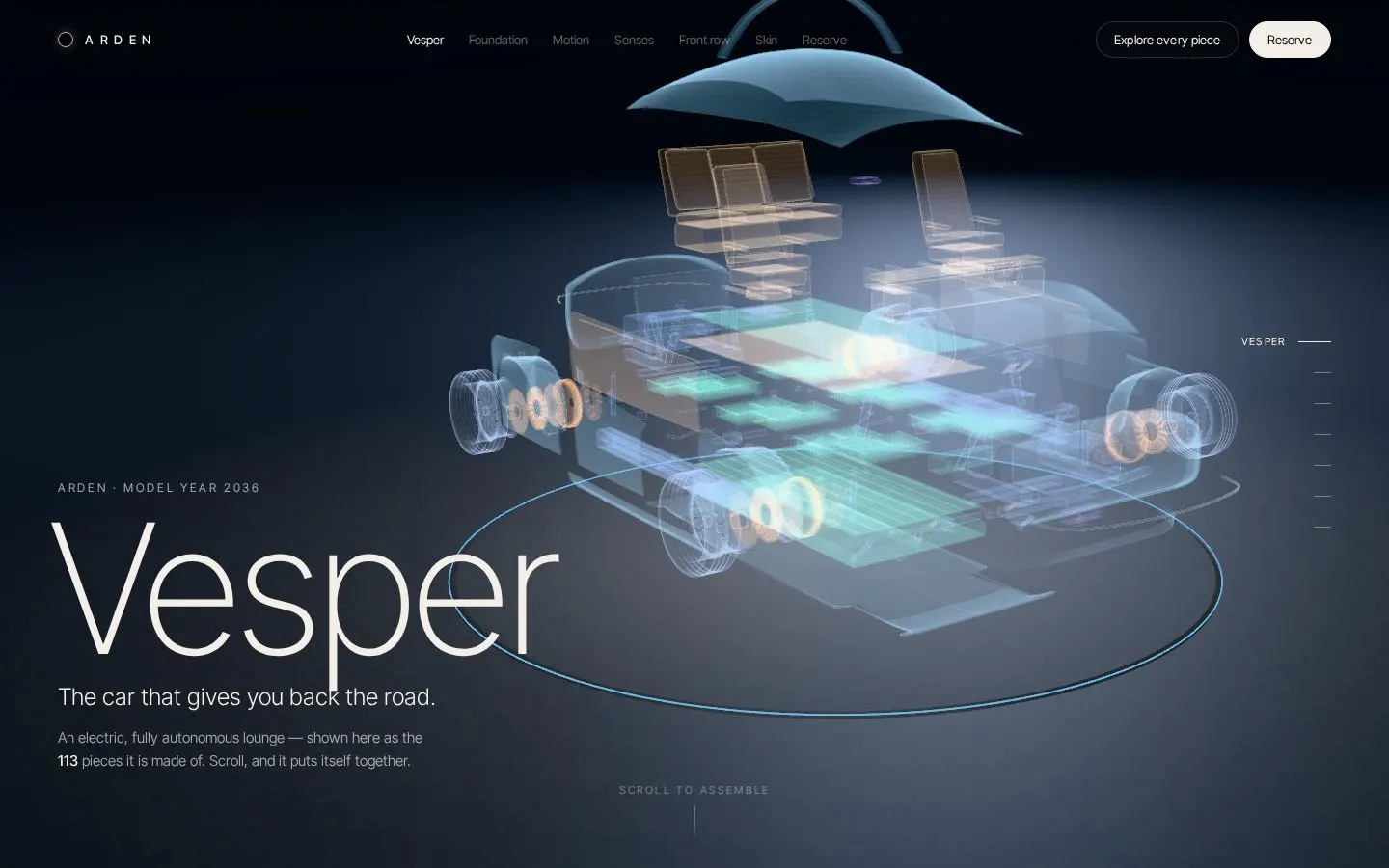
I've built Arden Vesper, a 2036 electric, fully self-driving lounge car, and a scroll-driven 3D launch page where it assembles itself from 113 X-ray pieces into the finished car. The production build serves correctly. A scripted run through every chapter and explore mode showed no console errors. I checked the look with headless screenshots at desktop and phone sizes. Smoothness on a real phone hasn't been measured.
Run it: run.json builds with npm install && npm run build and serves with vite preview on 127.0.0.1:$PORT. The stack is Vite and three.js.
The car. Every piece is generated in code, with no model files, textures, photos or HDR environments.
- Body: one continuous mathematical surface, drawn from side-view, plan-view and cross-section curves. The panels are cut out of it with real 4 mm gaps and wheel arches rolled into the panels. It has a single glass canopy, a cast champagne-coloured roof hoop ("the Halo"), and light lines wrapping the nose and tail.
- Motor, the main focus: each wheel has its own axial-flux motor with no gearbox. You can see 18 copper coils on soft-magnetic teeth between two discs of 16 alternating magnets, a ring-shaped inverter, a cooled housing and a small emergency brake calliper.
- A small physics model (mass, drag, rolling resistance, torque and power limits, efficiency) drives the three-phase currents. The coils glow in a rotating sequence that the magnets follow: amber when driving, blue when braking returns energy to the battery.
- Pulses run along the orange high-voltage cables in the direction the energy is flowing.
- The body pitches on its springs, which compress and stretch live.
- Front seats, the other focus: each one slides back, swivels 180° on its own ring to face the rear sofa, and reclines to about 160° with a fold-out leg rest. The yoke retracts into the dash, the pedals fold flat, and the console slides back, rises and opens into a table. The motions are sequenced so nothing collides.
- Underneath: a structural battery of 12 modules (192 cells), cast front and rear subframes, side rails, double-wishbone suspension, steering on both axles, and lidar, radar, cameras and the driving computer.
The showroom.
- Studio: a curved, seamless backdrop lit by a reflection environment generated from emissive softboxes, plus soft shadows and a gentle glow on the light lines.
- Mood: the room starts dark like a blueprint and warms to a pale gallery as the car is finished.
- Tour: seven chapters (Vesper, Foundation, Motion, Senses, Front row, Skin, Reserve) with slow damped camera moves and labelled hotspots.
- Motion has hold-to-accelerate and hold-to-regenerate buttons, live readouts, and a 1/24 slow-motion toggle so you can see the field turn.
- Front row has Drive, Lounge and Rest buttons.
- Senses shows lidar pulses and a point cloud of a street scene.
- The finale has five paint colours, specs and a Reserve button.
- Explore mode: free orbit, an assembled-to-exploded slider, an X-ray toggle, a drive simulation, seat modes, and tap any piece for its story.
- Performance: resolution and the glow effect step down automatically if the frame rate drops. Phones get a bottom text sheet with the car framed above it.
Things to know:
- The Reserve button only shows a thank-you message; it doesn't send anything.
- On a phone-shaped screen the car is cropped at the sides in some chapters. I widened the camera to compensate but didn't re-check the result.
- The glass canopy shows a soft white blob where it reflects the overhead softbox.
- The rear end still looks a little heavy.
npm packages: @fontsource-variable/inter-tight, three, puppeteer-core, vite
GPT-6.1 Sol ChatGPT Plus
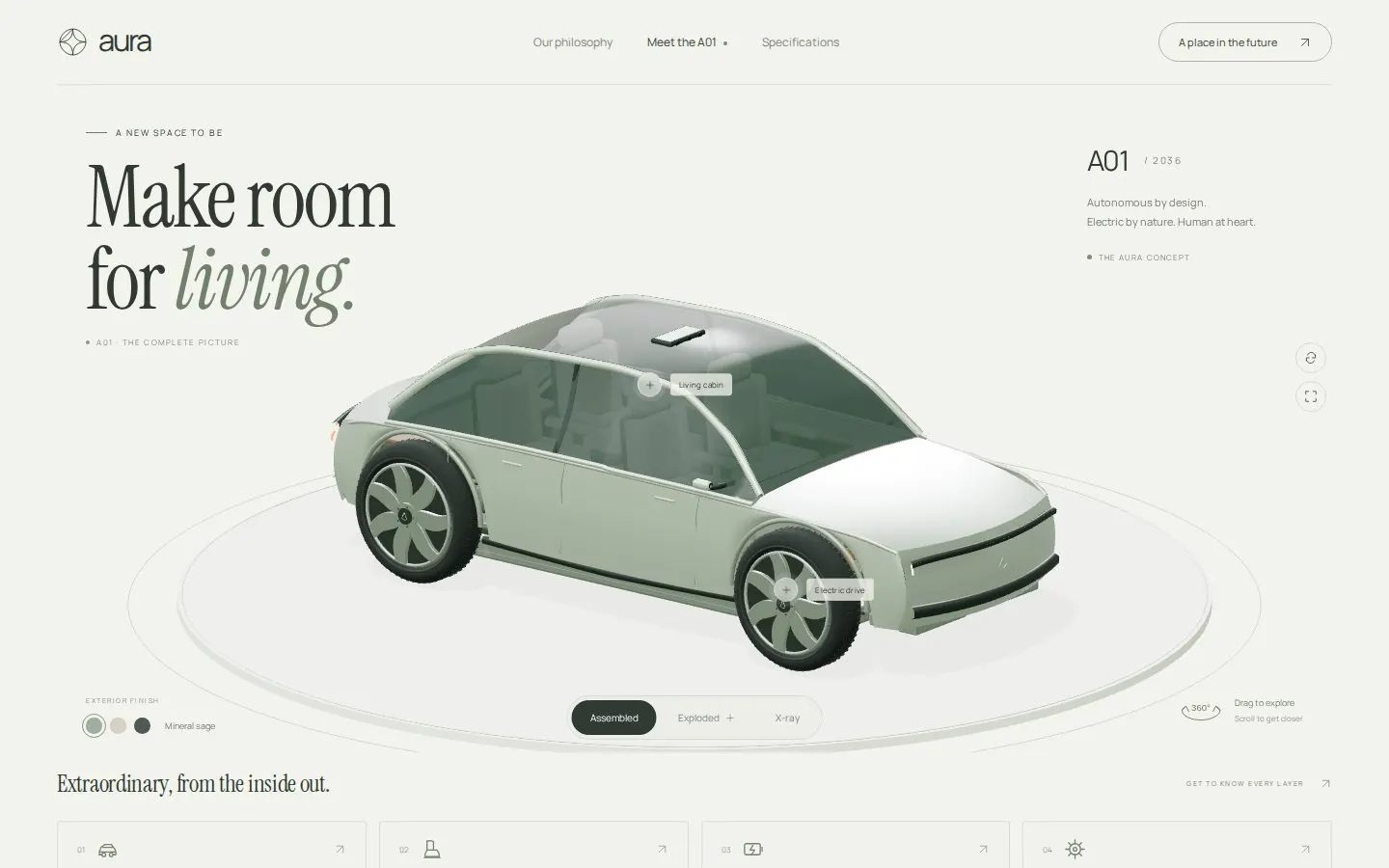
Built AURA A01, an original 2036 electric car in a responsive 3D showroom.
Includes explorable internals, swivel/reclining seats, animated motors, battery energy flow, exploded and X-ray views, and staged reassembly. All geometry and lighting are code-generated.
Production build and all three browser tests pass. run.json is ready.
npm packages: three, vite, @playwright/test
What was the prompt?
Both agents got this brief once, followed by the delivery contract that ends every prompt. Download the full prompt (.md)
A car from ten years ahead, in a 3D showroom, piece by piece
Design an electric, self-driving car from around 2036, and build a 3D web showroom where people can explore it.
The car is yours: its name, its shape, its story. Build the car itself in real detail, as a full simulation of the car rather than a beautiful shell. People should be able to see it like a puzzle: the car as transparent pieces they can explore, which come together into the finished car at the end. Put the most care into the front seats (what happens to them when nobody has to drive?) and the motor (how does this car actually move?).
The showroom should feel like the launch page of a real car company: beautiful light, calm camera moves. It has to run smoothly in an ordinary browser and on phones.
Rule: build the car and the room in code. Geometry, materials and lighting are yours to make. A 3D library is fine, but don't download or bundle ready-made 3D models, textures, photos or HDR environments (no .glb, .gltf, .obj, .fbx, .usdz, .hdr, .exr files, no images of cars).